

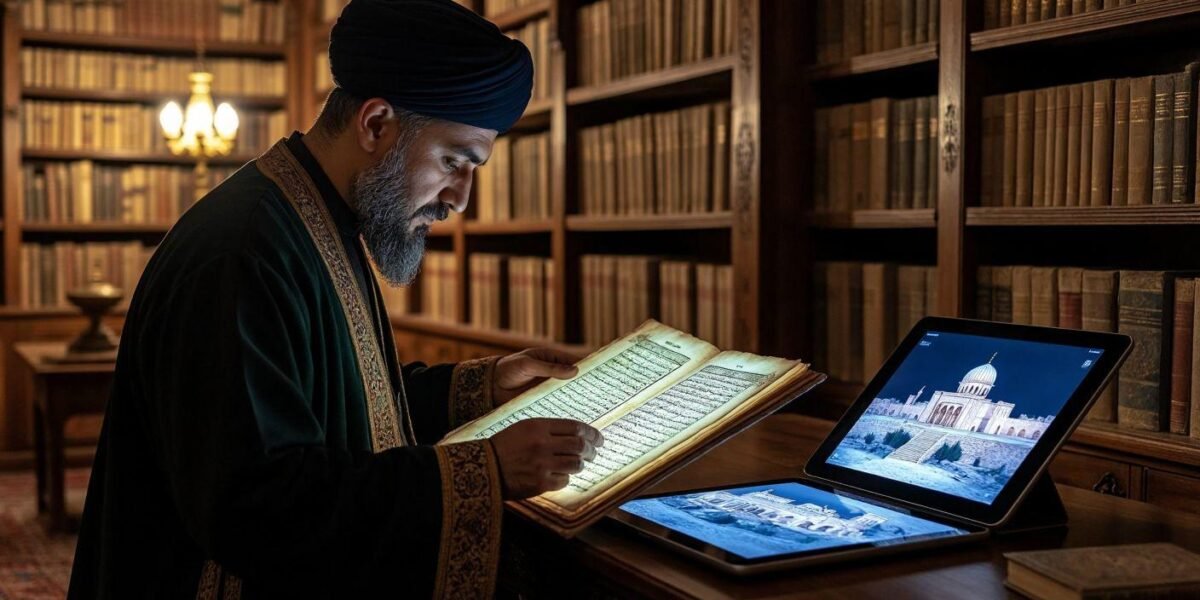
The world is experiencing a remarkable technological transformation. Artificial Intelligence (AI) is changing how people communicate, learn, conduct research, access information, and understand the world around them. From education and healthcare to business and scientific research, AI is becoming an important part of modern society.
However, one important question deserves our attention: How can Artificial Intelligence contribute to the development, preservation, and dissemination of Islamic knowledge, and how can Islamic scholars benefit from this revolutionary technology?
Islamic knowledge has been preserved and transmitted through generations by scholars, teachers, researchers, and institutions of learning. The Qur’an, Sunnah, Hadith, Tafsir, Fiqh, Aqidah, and other Islamic disciplines represent a rich intellectual heritage that requires careful study, authentic interpretation, and responsible transmission.
In this new digital era, AI presents an opportunity to strengthen Islamic education and research. When developed and supervised by qualified Islamic scholars, AI can become a valuable instrument for making authentic Islamic knowledge more accessible to Muslims and non-Muslims around the world.
The objective should not be to replace Islamic scholars with machines, but to empower scholars with technology so that they can serve humanity more effectively.
1. Understanding Artificial Intelligence in the Context of Islamic Knowledge
Artificial Intelligence refers to computer systems designed to perform tasks that normally require human intelligence. These tasks include understanding language, analysing information, identifying patterns, answering questions, translating content, and generating written material.
Modern AI systems can process enormous amounts of information in a relatively short time. This ability could be particularly useful in Islamic studies, where researchers often need to examine extensive collections of religious texts, historical documents, scholarly opinions, and academic publications.
For example, an AI-powered Islamic knowledge platform could help users:
- Search the Qur’an according to particular subjects and themes.
- Locate Hadith references and their available classifications.
- Explore different Tafsir explanations.
- Understand Islamic terminology and Arabic expressions.
- Translate Islamic educational materials into multiple languages.
- Compare scholarly discussions on particular issues.
- Access introductory explanations of Islamic beliefs and practices.
Nevertheless, AI-generated information must always be checked against authentic sources. AI systems can produce inaccurate statements, misunderstand religious contexts, or provide references that do not exist. Therefore, Islamic scholars must remain responsible for validating religious content.
2. Islamic Scholars Should Become Part of AI Development
One of the greatest opportunities in this technological revolution is the involvement of Islamic scholars in the development of AI systems.
Currently, many AI technologies are developed primarily by computer scientists, engineers, technology companies, and commercial organisations. Their technical expertise is essential, but developing reliable Islamic knowledge systems requires another important dimension: Islamic scholarly expertise.
Islamic scholars understand the principles of the Qur’an, Hadith, Tafsir, Fiqh, Usul al-Fiqh, Aqidah, and the historical development of Islamic intellectual traditions.
Their participation could help ensure that AI systems dealing with Islamic knowledge are designed with appropriate religious accuracy, context, ethics, and scholarly accountability.
A collaborative approach should bring together:
- Islamic scholars and qualified religious researchers.
- Qur’an and Hadith specialists.
- Arabic language experts.
- Islamic jurisprudence scholars.
- Computer scientists and AI engineers.
- Universities and Islamic research institutions.
- Digital education specialists.
Through this collaboration, Islamic scholars can help determine which sources are appropriate, how religious information should be categorised, and what safeguards are necessary when AI systems discuss sensitive religious matters.
The result could be a new generation of Islamic AI tools that combine technological capabilities with established Islamic scholarly methodologies.
3. Developing an AI-Powered Islamic Knowledge Database
One particularly valuable initiative would be the development of a comprehensive digital Islamic knowledge database.
Over many centuries, Islamic scholars have produced an enormous collection of knowledge, including books, manuscripts, commentaries, legal discussions, historical records, and educational materials.
Unfortunately, much of this knowledge remains difficult for ordinary people to access, particularly when it is available only in specialised libraries, printed publications, or languages they do not understand.
AI could help organise and make these resources more accessible.
For example, an Islamic knowledge database could include:
The Holy Qur’an: Verified Arabic text, translations, thematic indexing, and recognised Tafsir resources.
Hadith collections: Searchable Hadith texts, collection references, available grading information, narrators, and scholarly commentaries.
Islamic jurisprudence: Educational resources covering the different schools of Islamic jurisprudence, their methodologies, and recognised scholarly discussions.
Islamic history: Historical documents, biographies of scholars, the development of Islamic civilisation, and important historical events.
Islamic theology: Educational materials concerning Aqidah, Islamic beliefs, and recognised theological discussions.
Islamic literature: Classical and contemporary Islamic books, research papers, lectures, and scholarly publications.
With proper source verification and intelligent search capabilities, users could locate relevant Islamic information more efficiently.
Importantly, the database should distinguish between primary religious sources, scholarly interpretations, academic research, and general educational explanations.
4. Making Islamic Knowledge Accessible to the World
One of the most significant benefits of AI is its ability to overcome language barriers.
Islamic knowledge has historically been transmitted through Arabic and numerous other languages. However, millions of Muslims around the world do not speak or understand Arabic.
AI-powered translation systems could help translate carefully verified Islamic educational materials into English, Malay, Indonesian, Urdu, French, Chinese, Spanish, and many other languages.
This would create opportunities for:
- Muslims living in countries with limited access to Islamic educational institutions.
- New Muslims seeking reliable introductory Islamic knowledge.
- Students studying Islam in universities.
- Researchers examining Islamic civilisation and intellectual history.
- Non-Muslims interested in understanding Islam through authentic educational resources.
AI-powered educational assistants could also explain difficult Islamic terminology in simpler language while providing references to the original sources.
This would help make Islamic knowledge more accessible without compromising the importance of authentic scholarship.
5. Supporting Islamic Scholars in Research and Academic Development
Islamic scholars often spend considerable time reviewing books, locating references, comparing historical documents, and examining different scholarly opinions.
AI could assist with some of these research activities.
For instance, AI research assistants could:
- Search large digital collections of Islamic books and academic publications.
- Identify relevant passages from classical Islamic literature.
- Organise research materials according to particular subjects.
- Compare different translations and interpretations.
- Assist with Arabic-to-English and English-to-Arabic research.
- Prepare preliminary research summaries for scholarly review.
- Help organise references and bibliographies.
These capabilities could save researchers time and allow them to concentrate more deeply on interpretation, critical analysis, and scholarly investigation.
However, AI-generated summaries and references should never be accepted without checking the original publications. Scholars must retain control over the research process and its conclusions.
6. AI Should Support, Not Replace, Islamic Religious Authority
This is perhaps the most important principle in the relationship between Artificial Intelligence and Islamic knowledge.
AI can process information, identify patterns, and generate explanations. However, it does not possess the religious qualifications, scholarly training, lived experience, or moral responsibility of a qualified Islamic scholar.
Understanding Islam requires more than retrieving information from books. It involves knowledge of Arabic, the circumstances surrounding revelation, Hadith methodology, principles of jurisprudence, scholarly disagreement, and the broader objectives of Islamic law.
For example, when someone asks an AI system for a religious ruling (Fatwa), the answer may fail to consider important circumstances or differences in scholarly methodology.
Therefore, AI should not independently issue authoritative religious rulings or present its generated interpretations as established Islamic positions.
Instead, an AI system should be designed to:
- Provide references to recognised Islamic sources.
- Explain when scholarly opinions differ.
- Identify the relevant school of jurisprudence where applicable.
- Distinguish established knowledge from disputed interpretations.
- Refer complex religious questions to qualified scholars.
- Clearly communicate uncertainty when reliable information is unavailable.
The final responsibility for religious interpretation and authoritative guidance must remain with qualified human scholars and recognised religious institutions.
7. Applying Islamic Ethical Principles to Artificial Intelligence
The development of Islamic AI systems should be guided by Islamic ethical principles.
Several important principles deserve particular attention.
Amanah (Trustworthiness): AI developers and Islamic knowledge institutions must take responsibility for the accuracy, reliability, and appropriate use of religious information.
Ilm (Knowledge): Technology should contribute to the pursuit, preservation, and dissemination of beneficial knowledge.
Tabayyun (Verification): Religious information must be verified before it is presented as authentic or authoritative. This principle is especially relevant to AI-generated Hadith references and religious explanations.
Adab (Proper Conduct): AI systems should encourage respectful discussions, responsible communication, and appropriate treatment of Islamic texts and scholarship.
Adl (Justice): Islamic AI platforms should avoid unfair representation, discrimination, and misleading presentation of different scholarly traditions.
Maslahah (Public Benefit): AI development should aim to create genuine benefits for individuals and society while reducing potential harm.
These principles provide a foundation for responsible technological development in accordance with Islamic values.
8. Establishing an International Islamic AI Research Initiative
A major opportunity exists for Islamic universities, research institutions, scholars, and technology organisations to establish an international initiative dedicated to AI and Islamic knowledge.
Such an initiative could focus on developing an AI platform specifically designed to support Islamic education and research.
Possible areas of development include:
1. Islamic AI Research Centre
An interdisciplinary research centre involving Islamic scholars, computer scientists, and academic researchers.
2. Verified Islamic Digital Library
A structured digital library containing carefully reviewed Islamic texts, recognised publications, and scholarly resources.
3. Islamic AI Educational Assistant
An educational platform that helps students understand Islamic subjects and directs users to reliable references.
4. Qur’an and Hadith Research Tools
Specialised tools for searching, indexing, and examining religious texts under qualified scholarly supervision.
5. Global Islamic Knowledge Network
An international network connecting Islamic scholars, universities, libraries, and research organisations.
6. AI Training and Educational Programmes
Training opportunities to help Islamic scholars understand AI technology and enable technology professionals to understand the requirements of Islamic knowledge development.
Such an initiative could help bridge the gap between traditional Islamic scholarship and modern technological innovation.
9. Challenges and Responsibilities in Using AI for Islamic Knowledge
Although AI offers considerable opportunities, its use in Islamic studies also presents challenges that must be addressed.
Incorrect religious information: AI may generate inaccurate Qur’anic references, Hadith citations, or religious explanations.
Misinterpretation of sacred texts: Religious texts require context, linguistic understanding, and established interpretive methodologies.
Lack of scholarly accountability: AI systems cannot independently take responsibility for religious conclusions.
Bias in information: AI systems may favour particular sources, languages, or interpretations while overlooking others.
Copyright and intellectual property: Islamic publications and scholarly works must be digitised and used with appropriate permissions and respect for authorship.
Privacy and data protection: Personal information shared through religious AI platforms must be handled responsibly.
These challenges demonstrate why Islamic scholars should participate in the planning, development, testing, and governance of AI systems.
A reliable Islamic AI platform should have a formal scholarly review process, transparent sources, regular content evaluation, and clear procedures for correcting errors.
10. A Vision for the Future: Connecting Islamic Scholarship with Modern Technology
The future of Islamic knowledge should not be limited by the boundaries of traditional communication or geographical location.
A student in a remote village should have the opportunity to access authentic Islamic educational resources. A researcher should be able to locate relevant classical references without spending months searching through physical libraries. A new Muslim should be able to find reliable introductory materials in their own language.
AI could help make these possibilities a reality.
However, technological progress should always serve the higher objectives of knowledge, education, ethical development, and the benefit of humanity.
The involvement of Islamic scholars in AI development is therefore not simply an optional contribution. It is an important opportunity to ensure that emerging technologies respect the principles and intellectual foundations of Islamic scholarship.
Muslim scholars should not remain passive observers of the AI revolution. They should actively participate in shaping how this technology is developed and applied to Islamic education and research.
By working together with technology experts, they can help create digital platforms that preserve authentic knowledge, encourage critical thinking, and make Islamic education more accessible to future generations.
Conclusion
Artificial Intelligence represents a significant opportunity for the development and dissemination of Islamic knowledge.
It can support Islamic research, improve access to educational resources, facilitate multilingual learning, organise historical documents, and help scholars manage extensive collections of information.
Nevertheless, AI must remain a supporting instrument rather than an independent religious authority.
The Qur’an, Sunnah, established Islamic scholarship, and recognised principles of religious interpretation must remain the foundation of Islamic knowledge.
The most meaningful progress will come when Islamic scholars, researchers, educators, and technology professionals work together to develop responsible AI systems that serve the needs of the Muslim community and humanity as a whole.