
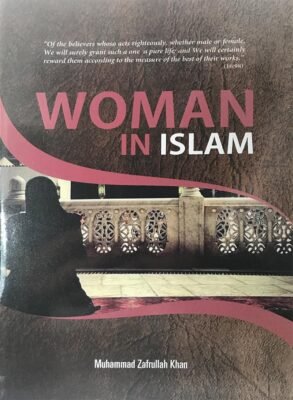
Woman in Islam, written by Sir Muhammad Zafrulla Khan, is an informative booklet that examines the status, rights, and responsibilities of women according to Islamic teachings. The author explores how the Holy Quran addresses women’s spiritual, social, and economic status and explains the principles governing marriage, divorce, and family life. The book aims to clarify common misunderstandings about the position of women in Islam and highlights the importance of justice, dignity, and moral responsibility.
Summary of the Book
The central theme of Woman in Islam is that women possess spiritual dignity and have responsibilities and rights recognized within Islamic teachings. The author draws primarily on Quranic teachings to explain the position of women and their role in family and society.
One of the important subjects discussed in the book is spiritual equality. The author explains that women and men are both accountable to Allah for their beliefs and actions. Spiritual progress is linked to faith, righteousness, and good conduct rather than gender alone.
Another major topic is marriage. The book examines marriage as an important social institution and discusses the rights and responsibilities of husbands and wives. It emphasizes the importance of family relationships and the moral principles that, according to the author, should guide married life.
The author also discusses divorce and polygamy, two subjects that frequently arise in debates about women’s rights in Islam. He presents his interpretation of the relevant Quranic teachings and explains these practices within the broader framework of Islamic law and social responsibility.
Furthermore, the book considers economic rights and the preservation of social and moral values. It highlights the recognition of women’s financial entitlements and the importance of fulfilling obligations within the family and wider community.
Critical Analysis
One of the main strengths of this booklet is its concise and focused presentation. The author addresses several important subjects in a relatively short work, making it accessible to readers who want an introduction to Islamic teachings concerning women.
Another strength is its reliance on Quranic principles. Rather than discussing women’s status solely through cultural traditions, the author attempts to establish his arguments through religious texts. This encourages readers to distinguish between Islamic teachings as interpreted by the author and social customs that may vary across communities.
The discussion of spiritual equality is particularly significant because it emphasizes women’s direct relationship with Allah and their individual moral accountability. The sections on marriage, divorce, and economic rights also introduce readers to important aspects of Islamic family and social life.
However, the booklet primarily presents the author’s religious interpretation. Readers seeking a broader academic understanding may wish to compare its arguments with other Muslim interpretations, historical studies, and contemporary discussions of gender and family law. Such comparisons can provide a fuller understanding of how these principles have been interpreted and applied in different societies.
Relevance to Contemporary Society
The themes explored in Woman in Islam remain relevant to contemporary discussions about women’s dignity, religious identity, marriage, financial independence, and family responsibilities.
The book encourages readers to examine the religious principles underlying women’s rights and to consider the importance of justice and ethical conduct in family relationships. Its discussion of marriage and divorce is particularly relevant to conversations about mutual obligations, personal dignity, and the protection of individual rights.
It also offers an opportunity to reflect on the difference between religious teachings and cultural practices. Understanding this distinction is important when examining the experiences of Muslim women in different communities.
Conclusion
In conclusion, Woman in Islam by Sir Muhammad Zafrulla Khan is a concise and informative introduction to the author’s understanding of women’s status and rights within Islam. It explores spiritual equality, marriage, divorce, polygamy, and economic responsibilities through a religious perspective grounded primarily in Quranic teachings.
Although readers seeking a more comprehensive historical or comparative analysis may benefit from consulting additional sources, the booklet provides a useful starting point for understanding important Islamic discussions concerning women.
Overall, this work is recommended for readers interested in Islamic studies, women’s rights, and religious perspectives on family and society. It encourages thoughtful reflection on the relationship between faith, justice, dignity, and the responsibilities that shape individual and community life.