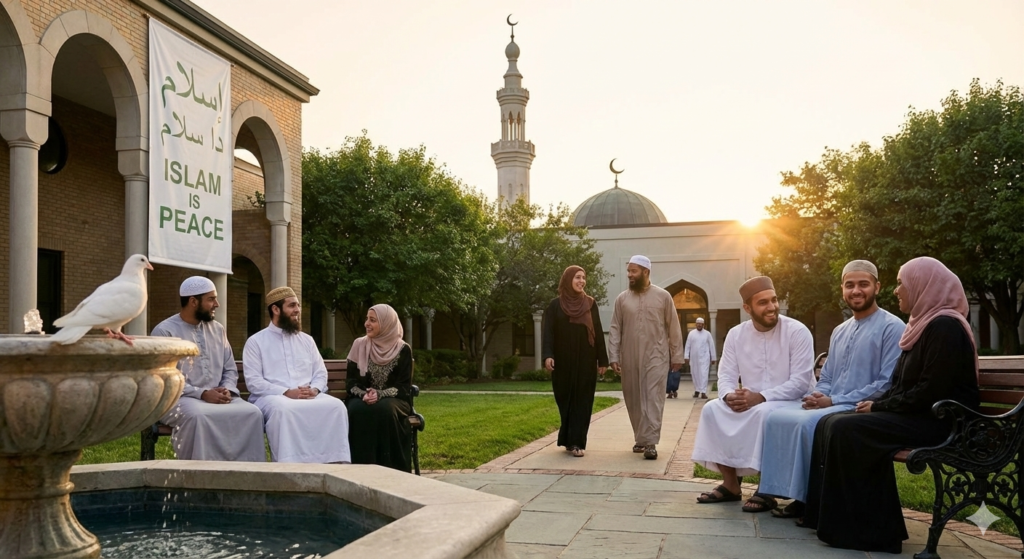
Islam is a complete way of life, encompassing belief, practice, ethics, and law. At its core are the five pillars of Islam, which serve as the foundation of a Muslim’s faith and actions. These pillars are not merely rituals; they embody a framework for spiritual development, moral responsibility, and social cohesion. Each pillar reinforces the others, guiding believers toward obedience to Allah and alignment with His divine will.
1. Shahadah (Declaration of Faith)
The Shahadah, or testimony of faith, is the first and most fundamental pillar. It declares:
“La ilaha illa Allah, Muhammadur Rasoolu Allah” – “There is no deity but Allah, and Muhammad is the Messenger of Allah.”
This declaration affirms two critical beliefs: the oneness of Allah (Tawheed) and the prophethood of Muhammad (peace be upon him). The Shahadah is more than a statement; it is the gateway to Islam. By sincerely professing it, a person enters the fold of Islam, committing to a life centered around the worship of Allah and adherence to His guidance.
Theologically, the Shahadah emphasizes monotheism, a principle that shapes all aspects of a Muslim’s faith and practice. Socially, it unites the Muslim community under a shared belief system.
2. Salah (Prayer)
Salah, the ritual prayer, is performed five times daily: at dawn, midday, mid-afternoon, sunset, and night. This practice establishes a rhythm of worship throughout the day, constantly reconnecting the believer with Allah.
Salah fulfills several purposes:
-
Spiritual Discipline: Regular prayer cultivates mindfulness and piety.
-
Physical and Mental Concentration: The physical actions of bowing and prostration reinforce humility and submission.
-
Social Cohesion: Congregational prayers, particularly on Fridays, strengthen communal bonds.
Salah is not optional; it is an obligatory act of worship for every adult Muslim and a constant reminder of accountability before Allah.
3. Zakah (Almsgiving)
Zakah, or obligatory charity, requires Muslims to donate a fixed portion of their wealth, usually 2.5% of accumulated savings, to eligible recipients. Zakah serves multiple purposes:
-
Economic Justice: It redistributes wealth, helping reduce inequality.
-
Spiritual Purification: Giving purifies the soul from greed and attachment to worldly possessions.
-
Social Welfare: It supports the poor, the destitute, and those in debt, reinforcing communal solidarity.
Zakah is a demonstration of compassion and a tangible expression of faith in action. Unlike voluntary charity (sadaqah), Zakah is a compulsory duty and a fundamental component of Islamic economic ethics.
4. Sawm (Fasting in Ramadan)
Sawm, the fast observed during the month of Ramadan, requires abstention from food, drink, sexual activity, and sinful behavior from dawn to sunset. The fast is a form of spiritual discipline that promotes:
-
Self-Control: Resisting physical desires fosters restraint and mindfulness.
-
Empathy: Experiencing hunger cultivates compassion for the less fortunate.
-
Spiritual Growth: Fasting encourages reflection, prayer, and detachment from worldly distractions.
Ramadan is also a time of community engagement, as families and neighbors break the fast together, and mosques organize communal prayers and charitable activities.
5. Hajj (Pilgrimage to Mecca)
Hajj is the pilgrimage to Mecca, required once in a lifetime for those who are physically and financially able. It occurs annually in the Islamic month of Dhul-Hijjah and includes a series of rituals performed at specific locations:
-
Tawaf: Circumambulating the Kaaba.
-
Sa’i: Walking between Safa and Marwah.
-
Standing at Arafat: Seeking forgiveness and reflecting on divine mercy.
Hajj embodies unity, equality, and submission, as millions of Muslims from diverse backgrounds gather in a shared act of worship. It is both a spiritual renewal and a demonstration of solidarity among the global Muslim community.
Interconnectedness of the Pillars
The five pillars are interdependent. Shahadah provides the theological foundation, while Salah, Zakah, Sawm, and Hajj operationalize the faith. Together, they nurture both the individual’s spiritual development and societal well-being.
For instance, Salah reinforces the consciousness of Allah emphasized in Shahadah; Zakah and Sawm cultivate empathy and social responsibility; Hajj fosters a sense of universal unity. The pillars, therefore, create a holistic system of personal and communal ethics.
Conclusion
The pillars of Islam are not mere rituals; they are dynamic frameworks that shape the moral, spiritual, and social dimensions of a Muslim’s life. Through the Shahadah, Salah, Zakah, Sawm, and Hajj, believers express devotion, cultivate virtue, and strengthen the bonds of the global Muslim community.
By understanding and implementing the pillars faithfully, Muslims not only fulfill their religious obligations but also contribute to a just, compassionate, and spiritually conscious society. In essence, the pillars are the bedrock upon which Islamic life stands, guiding every aspect of faith and practice.