Articles

The Good Muslims Daily Activities

A good Muslim’s life is guided by faith, discipline, and a constant awareness of Allah. Islam is not limited to rituals alone; it is a complete way of life that shapes daily routines, character, and interactions with others. From the moment a Muslim wakes up until going to sleep, every action can become an act of worship when done with
Read More »

The 99 Names of Allah SWT Asma’ul Husna and Their Significance

In Islam, Allah SWT is known by many names, each reflecting a unique aspect of His divine attributes. These names, known collectively as Asma’ul Husna (the Most Beautiful Names), are mentioned in the Qur’an and Hadith and serve as a guide for Muslims to understand, worship, and build a closer relationship with their Creator. There are 99 names traditionally recognized,

Read More »

The Powerful Storytelling Style of the Qur’an

Stories make up approximately one-third of the Qur’an, the most profound book of guidance ever revealed to humanity. From the very first chapter, al-Fātiḥah, believers are encouraged to seek guidance along the Straight Path, a path illuminated by the examples of those “favored by God.” This framing demonstrates that stories are far more than entertainment—they are powerful tools for moral

Read More »

Islamic Parenting Strategies: Raising Children with Faith and Compassion

Parenting in Islam is a profound responsibility, combining guidance, love, and spiritual development. Many Muslim parents, like Mona and Ibrahim, enter parenthood with the best intentions, hoping to raise children who are morally upright, spiritually connected, and committed to Islam. However, the reality of daily family life often brings challenges they did not anticipate. Mona and Ibrahim grew up in

Read More »

Shirk: Why It Is Considered the Greatest Sin in Islam

Human beings have always sought answers to the deepest questions of existence—why we are here, what happens after death, the nature of good and evil, and the reality of God. Some scholars even describe humans as Homo Religiosus, a species defined not only by intelligence but by a natural inclination toward spirituality and religious inquiry. Even in today’s modern world,

Read More »

Imam Abu Hanifa and the Hanafi school of thought in Islam

Imam Abu Hanifa (699–767 CE) Full Name: Nu‘man ibn Thabit ibn Zuta al-KufiBirthplace: Kufa, Iraq Imam Abu Hanifa is one of the most renowned scholars of Islamic jurisprudence and the founder of the Hanafi school, which is the oldest of the four major Sunni schools of law. Early Life and Education He was born in 699 CE in Kufa, a

Read More »

Imam Malik ibn Anas school of thought in Islam

Imam Malik was one of the most prominent Islamic scholars and jurists. He was born in Medina, Saudi Arabia, in 711 CE. Medina was the city of the Prophet Muhammad ﷺ, and Imam Malik grew up in an environment deeply connected to the traditions and practices of the Prophet’s companions (Sahaba). Education: Imam Malik studied under many scholars of his

Read More »

Imam Ahmad ibn Hanbal the Islamic School of Imam Hanbali

Full Name: Ahmad ibn Muhammad ibn HanbalBirth/Death: 164–241 AH / 782–856 CEPlace of Birth: Baghdad Imam Ahmad ibn Hanbal was born in Baghdad, then the thriving capital of the Islamic world, renowned for its centers of learning and numerous scholars. From a young age, he displayed remarkable intelligence and devotion, memorizing the Qur’an and immersing himself in Islamic sciences. He

Read More »

Imam Al-Shafi‘i the islamic school of Shafi‘i

Full Name: Abu ‘Abdullah Muhammad ibn Idris al-Shafi‘iBirth/Death: 150–204 AH / 768–820 CEPlace of Birth: Gaza Imam Al-Shafi‘i was only two years old when his mother brought him to Makkah, the city of his father’s family. Raised by his devout mother, he displayed remarkable intellectual abilities from a young age. By the age of seven, he had memorized the Qur’an,

Read More »

The Four Schools of Fiqh and the Four Imams of Islam

Islamic jurisprudence, or fiqh, refers to the understanding and application of Shariah (Islamic law) based on the Qur’an, Sunnah, consensus (ijma’), and reasoning (ijtihad). Over time, scholars developed systematic approaches to interpreting these sources, leading to the establishment of four major Sunni schools of jurisprudence. These schools are named after the Imams who founded them: Abu Hanifah, Malik ibn Anas,

Read More »

Hajj in Islam: The Pillar of Pilgrimage

Hajj, the fifth pillar of Islam, is a sacred pilgrimage to the holy city of Makkah in Saudi Arabia, required of every adult Muslim who is physically and financially able to undertake it at least once in their lifetime. Unlike other forms of worship, Hajj is both a personal spiritual journey and a profound communal experience, symbolizing equality, devotion, and

Read More »

Solat in Islam: The Pillar of Spiritual Discipline

Solat (also spelled Salah) is the second pillar of Islam and refers to the ritual prayer that every adult Muslim is obligated to perform. It is the most direct form of worship, serving as a daily connection between the believer and Allah. Solat is not only a physical act but also a spiritual discipline that cultivates mindfulness, obedience, and moral

Read More »

The Pillars of Islam: Foundations of Faith and Practice

Islam is a complete way of life, encompassing belief, practice, ethics, and law. At its core are the five pillars of Islam, which serve as the foundation of a Muslim’s faith and actions. These pillars are not merely rituals; they embody a framework for spiritual development, moral responsibility, and social cohesion. Each pillar reinforces the others, guiding believers toward obedience

Read More »

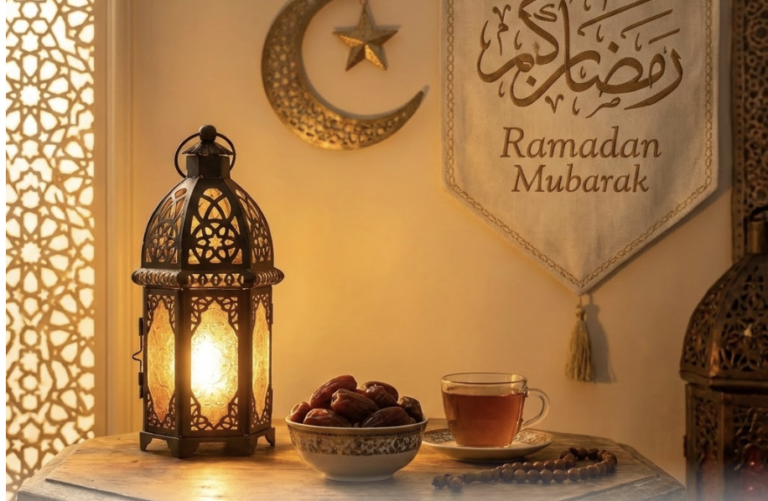
The Holy Month Ramadan Mubarak

Ramadan is the ninth month of the Islamic lunar calendar and holds deep spiritual significance for Muslims around the world. It is a time of fasting, prayer, reflection, and compassion, observed from dawn (Fajr) until sunset (Maghrib). Muslims greet one another with the words “Ramadan Mubarak,” meaning “Blessed Ramadan,” to share goodwill and joy during this sacred period. Fasting during

Read More »

The Prophet Muhammad’s ﷺ Daily Prayers

When the Prophet Muhammad (pbuh) wakes up, he recites the following prayers All praise is due to God who gives us life after causing us to die, and to Him is the final return. There is no deity worthy of worship except You; I declare You free from all imperfections. O God! I seek forgiveness from You for my sins

Read More »

Rajab Month Diary

Jumada al-Akhir (Last Week) Drought in Medina (9th Year) The Activities of Abu Amir al-Fasiq Seeking Refuge with the Byzantines Convincing the Byzantines to go to war Efforts to keep hostilities alive by the hypocrites and some jews in Medina The Construction of the Mosque of Dhirar Events Before the Expedition of Tabuk (9th Year) The Ghatafan tribe’s encouragement letter sent to

Read More »
Scroll to Top